

Accent Reduction Apps vs. Working with an Accent Coach: An Honest Comparison
Why This Comparison Matters More Than Ever
You have probably seen the ads by now. Download this app. Spend ten minutes a day. Watch your accent disappear.
It sounds appealing, especially if you are a professional who already speaks fluent English but keeps running into the same wall: people asking you to repeat yourself in meetings, colleagues talking over you before you finish a thought, or that quiet hesitation before you speak up on a call because you are not sure your words will land the way you intend them to.
The accent reduction market has exploded over the past few years. Apps like BoldVoice, ELSA Speak, and ChatterFox have raised millions in venture capital, and they are marketing aggressively to the same professionals who would traditionally seek out an accent coach. Meanwhile, personalized accent reduction training continues to grow, with more coaches than ever offering one-on-one sessions online.
So which option actually works? And more importantly, which one works for you?
The answer is not as simple as “apps are cheap, coaches are expensive, pick your budget.” There are fundamental differences in what each approach can and cannot do. This article breaks those differences down without the sales pitch, because what you choose should depend on your goals, your starting point, and how you actually learn.
What Accent Reduction Apps Actually Do Well
Let’s give credit where it is due. The best accent reduction apps have gotten remarkably good at a few specific things.
Sound-Level Pronunciation Feedback
Modern apps use AI-powered speech recognition to analyze your pronunciation at the phoneme level. That means they can detect whether your tongue placement for the American /r/ is off, or whether you are substituting a sound from your native language when producing the “th” in English. The instant feedback loop is genuinely useful for building awareness of sounds you may not have realized you were producing differently.
Consistency and Repetition
Speech is a physical skill. Your mouth, tongue, and jaw need to build new muscle memory. Apps make it easy to practice every single day because they are always available, they require no scheduling, and most sessions take under fifteen minutes. That kind of daily repetition is difficult to replicate with any other format, including working with a coach, unless you are also doing homework and practice outside of your sessions.
Affordability and Accessibility
Most accent reduction apps cost between $15 and $50 per month. Compare that to personalized accent reduction classes, which typically range from $100 to $250 per session, and the math is obvious. If budget is a primary constraint, an app gives you access to structured pronunciation content that simply did not exist five years ago.
Structured Curriculum
The better apps walk you through American English sounds in a logical sequence, starting with the consonants and vowels that tend to cause the most confusion for non-native speakers, then progressing into word stress, sentence rhythm, and intonation. For someone who has never had any formal accent reduction training, this structured introduction can be a valuable starting point.
Where Accent Reduction Apps Fall Short
Here is where the honest part of this comparison begins. Because for all the things apps do well, there are critical limitations that most app marketing conveniently ignores.
Apps Cannot Hear What a Coach Hears
AI speech recognition has improved significantly, but it is still analyzing your speech against a database of sound patterns. It can tell you that a particular phoneme does not match the target sound. What it cannot do is understand why you are producing that sound the way you do.
An experienced accent coach listens to you speak and immediately identifies the underlying pattern. Maybe you are not just mispronouncing the American /r/ in isolation. Maybe your jaw tension is affecting every vowel in the sentence. Maybe the issue is not the sound itself but the rhythm and stress pattern of the phrase, which changes how the listener perceives each sound.
Apps treat sounds as isolated data points. A coach hears your speech as a connected system.

Apps Cannot Adapt to Your Professional Context
If you are an engineer who needs to present quarterly updates to a leadership team in San Francisco, your accent reduction training needs to address the specific vocabulary, phrasing, and communication patterns of that context. If you are a physician explaining treatment options to patients, the stakes of clarity are entirely different.
Most accent reduction apps deliver generic practice content. They cannot pull vocabulary from your actual work presentations. They cannot simulate the conversational dynamics of your Monday stand-up meeting. They cannot adjust their approach because you mentioned that your biggest struggle is not individual sounds but speaking confidently during unscripted Q&A sessions.
A personalized accent-correction course with a coach is built around your real life. An app is built around a curriculum designed for everyone.
Apps Cannot Address the Emotional Side of Accent Work
This is something almost nobody talks about in app reviews, but it is one of the most significant factors in whether someone actually improves.
Many professionals carry real emotional weight around their accent. They have experienced being dismissed, being interrupted, or being silently judged as less competent because of how they sound. That experience creates habits that go beyond pronunciation: speaking too quickly, avoiding certain words, staying quiet in groups, or over-rehearsing every sentence before saying it out loud.
No app can recognize those patterns. No app can say, “I notice you tend to rush through the second half of your sentences. Let’s slow down and figure out what is driving that.” A good accent coach works with the whole person, not just the sounds coming out of their mouth.
Apps Plateau Without External Feedback
One of the most common stories I hear from professionals who come to coaching after using an app is some version of this: “I used it for a few months. My scores went up. But nothing changed at work. The reason is that apps measure pronunciation accuracy in controlled practice scenarios. They cannot measure whether your speech actually improved in the moments that matter: a client call, a job interview, a heated team discussion where you need to hold the floor.
Real progress in accent reduction training requires someone who can assess your speech in context and help you transfer what you have practiced into the unscripted, unpredictable situations of your professional life.
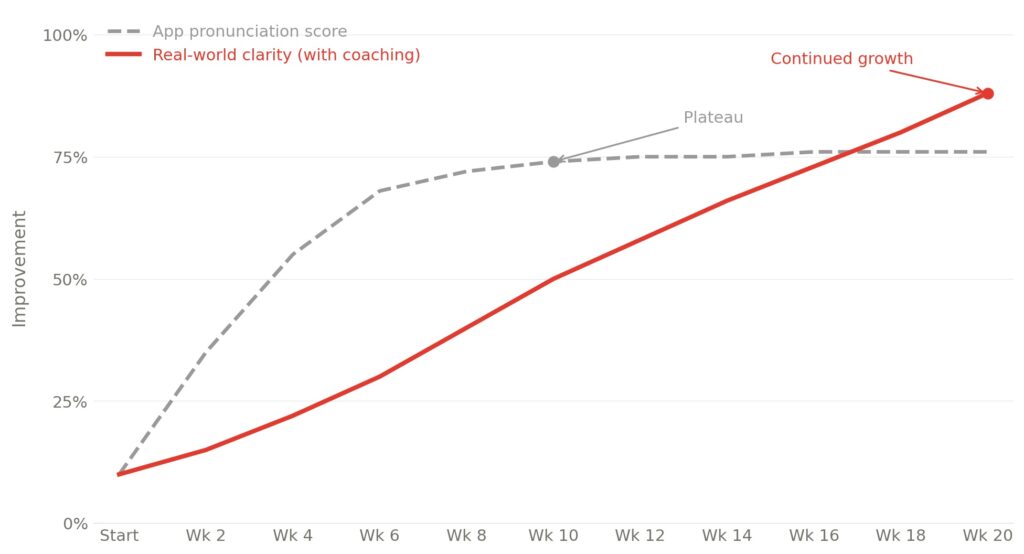
App pronunciation scores rise fast but flatten early. Real-world clarity with personalized coaching keeps building well beyond where apps stop.
What Personalized Accent Coaching Delivers That Apps Cannot
A Diagnostic That Shapes Your Entire Program
Before any accent reduction classes begin, a qualified accent coach conducts a detailed diagnostic assessment. This is not a quiz or an automated score. It is a conversation where the coach listens to your natural speech, identifies the specific patterns affecting your clarity, and designs a training program around those findings.
Two people might both struggle with “sounding clear in English.” But one might need focused work on vowel sounds and syllable stress, while the other might need to address intonation patterns and pacing. A diagnostic ensures you spend your time on the things that will make the biggest difference for you, not working through a generic sequence of lessons.
Real-Time Correction in Natural Speech
When you work with an American accent coach one-on-one, you are not just drilling sounds. You are speaking, getting interrupted mid-sentence with a correction, adjusting, and continuing. This is how pronunciation changes actually stick. Your coach can catch the exact moment your old pattern kicks in and help you redirect it before it becomes automatic again.
Apps can only evaluate what you say after you say it. A coach works with you in the moment.
Accountability and Momentum
Accent modification takes time. Most professionals need at least eight to fifteen weeks of consistent work to see changes that show up in their daily communication. That is a long runway, and motivation naturally fluctuates.
Good coaches provide external accountability. You have sessions on the calendar. You have homework to complete. Someone is tracking your progress and adjusting the plan based on what is working and what is not. That structure keeps you moving forward through the weeks when you feel like nothing is changing, which is a normal part of the process.
Integration with Broader Communication Skills
Accent clarity is only one piece of how you come across as a speaker. Your pacing, your volume, your use of pauses, the way you structure your sentences, your eye contact and body language on video calls: all of these affect whether people perceive you as confident and clear.
A good accent coach works on these elements alongside pronunciation, because in professional settings, clarity without confidence does not move the needle.
When an App Makes Sense
Not everyone needs a coach, and not everyone is ready for coaching. An accent reduction app can be the right choice if you/your:
- have a strong ear and high self-awareness. Some learners genuinely can identify their own errors, compare them to the target, and self-correct over time. If you are this type of learner, an app may give you enough feedback to make meaningful progress on your own.
- goals are modest and specific. If you want to clean up the pronunciation of a handful of sounds for a particular situation, an app might be sufficient. If you want a comprehensive shift in how you sound across all professional contexts, that requires more than an app can offer.
When You Need an Accent Coach
Coaching is the stronger investment when the stakes of your communication are high, and the changes you need go beyond isolated sounds. Consider working with an accent coach if you/your:
- have been asked to repeat yourself regularly in professional settings, and it is affecting how people respond to your ideas. This is not a pronunciation problem that isolated drills will solve. It is a communication pattern that needs to be diagnosed, addressed, and reinforced in the context of your actual work.
- have tried self-study or an app and hit a plateau. Progress stalled because you need someone who can identify the deeper patterns you cannot hear yourself.
- career is at a point where how you communicate matters as much as what you know. Promotions, leadership visibility, client-facing roles, public speaking invitations: these opportunities often depend on whether others perceive you as clear and confident.
- want lasting change, not temporary improvement. The difference between a score going up on an app and your colleagues noticing that you sound different in meetings is enormous. Coaching bridges that gap.
Still unsure if it’s worth it, read this blog post. Are Accent Reduction Classes Worth it?
The Honest Bottom Line
Accent reduction apps and accent coaching are not competitors. They solve different problems at different stages of the process.
Apps are tools. They are useful for building foundational awareness, getting daily reps, and supplementing structured training. For a professional who needs to communicate clearly and confidently in demanding environments, they are a starting point.
Coaching is a process. It is diagnostic, personalized, and responsive to who you are, what you do, and how you speak in the moments that count. For the professional whose clarity directly affects their career trajectory, coaching delivers what an app structurally cannot.
The question to ask yourself is not “which one is cheaper?” It is “what kind of change am I trying to make, and what does that change actually require?”
If you are not sure where you fall, a 30-minute consultation with me can give you more clarity in half an hour than weeks of researching apps and reading reviews. That conversation alone will tell you whether your goals are app-level goals or coaching-level goals.
And if it turns out an app is the right fit for now? A good coach will tell you that, too.
Check out my latest YouTube short on the subject.
About the Author: Jay Alexander Poulton is the founder of The Accent Coach, offering personalized accent reduction training and communication coaching to professionals worldwide. With twenty years in professional communications, nine of them coaching one-to-one, Jay works with clients across 25+ countries to build clarity, confidence, and presence in every conversation that matters.